ENERGY IS EVERYTHING AND EVERYTHING IS ENERGY AND THE SUM OF EVERYTHING IS ONE
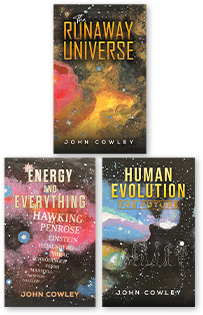
In his book Energy and Everything published
by Austin Macauley in 2025 the author concluded that all matter consisted entirely
of energy. A relationship described by Einstein in his classical equation and violently
illustrated by the process of nuclear fission and fusion. Upholding a
fundamental principle of science which states that energy can neither be
created or destroyed leads to the conclusion that the entire universe has
always existed in some dynamic combination of matter and energy and will
continue to exist ad infinitum as it cycles between matter and energy, dark
matter and dark energy.
Einstein described the centre of a black
hole as a dimensionless point, a singularity. No one is quite sure about the
nature of a singularity, is it nothingness, everything reduced to zero or is it
something substantial, a new form of reality? The author presents an argument
to support the latter concept and in doing so looks to redefine the term infinity
as the boundless reach of the human imagination. The universe can be as large
or as small as we conceive it to be within our human consciousness, but it is
never zero. The sum of everything is always one. Why one?
Many cosmologists compare the universe to the
surface of a balloon inflated by the force of the Big Bang. The observable
universe exists within the fabric of the balloon; the inside of the balloon stands
for the past and the outside of the balloon for the future. Time flows unevenly
along the expanding surface; warped by the presence of large masses like black
holes. Gravity and time appear to conflict with each other; time brings about
an increased expansion of space whilst gravity crushes space and time into a
singularity.
The expanding sphere, Big Bang, increases
in radius producing corresponding increases in the surface area, and volume of
the sphere. The formula relating surface area and volume to the radius are well
known and critically involve raising the power of the given value for the
radius (r) to r^2 and r^3 respectively. The reader might wish to refresh their
memory of some long-forgotten school lessons at this stage. The power of any
number is the product of multiplying the number by itself for as many times as
the power requires eg 2 to the power 2, 2^2=4, 2^3=8, 2^4=16 and so on. It is
obvious that 2 to the power 1, 2^1 is 2, as is any number to the power one,
99^1 is 99. An interesting situation arises when we consider any number to the
power zero, 2^0, 3^0 and onwards to as large a number as you can imagine.
Common sense might suggest that the product of any number to the power zero is
zero but that would be wrong. Every number to the power zero is one, 99^0=1, 1,000,000,000^0=1.
If in doubt the reader is invited to check the math for themselves.
The same math applies to both the
contraction and expansion of any sphere, each being the reverse of the other, applicable
to both the expanding universe and to the contracting space around a black hole.
Whatever units you choose to measure the shrinking sphere of space around the
black hole or however large the number of units involved, the zero power of
that number will always be one. The singularity at the heart of a black hole is
exactly what it implies, single, unit value 1. Extending the same math to questions
relating to both the origin of our universe and to it its ultimate destiny is
both enlightening and controversial.
Observation of the current state of the universe
based on light waves received from the most distant galaxies show that it is
expanding at an ever-increasing rate. Analysing the spectrum of light from
distant astronomical objects reveals a shift in the wavelength towards the red
end of the spectrum and the further away they are the greater is the degree of
shift involved. By comparing the red shift in the spectrum of any new observation
with the red shift of stars of a known distance it is possible to gain some
measure of the vast distances involved between us and the furthest galaxies and
stars.
In his books Energy and Everything and The
Runaway Universe the author has challenged the idea of an unstoppable expansion
of the universe that would lead to what has termed by some as ‘heat death’ and suggests
instead a cyclic universe subject to alternating phases of expansion and
contraction. The idea of a cyclic universe is based on two concepts, firstly that
nothing can travel faster than light, and secondly that the force of gravity
never reaches zero regardless of distance. The force of gravity is subject to
the inverse square law which mean that doubling the distance reduces the force
to one quarter, tripling the distance reduces the force to one ninth but the
force of gravity never reaches zero.
Comparing the expanding universe to the
surface of a balloon inflated by the force of the Big Bang means that every
point on the surface of the cosmic balloon is moving away from every other
point. Changes in the red shift in the light spectrum coming from bodies at
increasing distances from us suggests that the rate of expansion is
accelerating. However, this acceleration cannot be sustained indefinitely
because the speed at which the points are separating from each other cannot exceed
the speed of light. Before reaching the speed of light the acceleration phase
will begin to slow and eventually end but the points on the cosmic balloon will
continue to move apart at great speed and unopposed could continue indefinitely.
The surface of the cosmic balloon will continue to be stretched until, like a plastic
balloon, the elastic limit of the material is reached. It would then require an
added force to ‘burst the balloon’, overcome the cohesive force of gravity. The
only force now acting on the separating points is the force of gravity and
despite its extreme weakness over great distances it will begin to slow down
the speed of separation and eventually cause the surface of the cosmic balloon to
wrinkle and contract.
It is conceivable that this contracting
phase could continue until we reach a super massive black hole and beyond so
that the entire universe ends up as a singularity with the potential promise of
a new beginning, a new Big Bang. However, the observed universe is far from
homogenous, it is lumpy and matter is unevenly distributed about the surface of
the cosmic balloon. The formation of black holes is taking place continually regardless
of whether the cosmic balloon is expanding or contracting. Living on a planet orbiting
a star located in a region dominated by a supermassive black hole would lead
astronomers to believe that ‘their’ universe was contracting in contrast to the
situation on planet earth.
Is it possible that the Big Bang origin of
‘our’ universe is just a local event and at other locations on the surface of
the cosmic balloon the universe appears to be contracting. Are there numerous
locations where different phases of expansion and contraction are occurring in
some kind of synchrony, a cosmic ballet that goes on continuously in different
locations from big bang to singularity, from prologue to curtain call. Time for
all the players to take a bow and prepare for the next performance on a stage
somewhere near you.
Post Views : 24