FAMILY – the sum of everything is One
The word family has different meanings for different people
according to their culture and the context in which the word is both written
and spoken. In many cultures, the word family used in its simplest context
relates to a group of one or two adults living with their child or children as
a unit. In a wider context the word family relates to all the descendants of a
common ancestor, used in a biblical sense ‘the family of Abraham’. In an even
wider biological context, the word family signifies a wider and more inclusive
group than is present within any genus or any species. For example, Humans –
genus Homo, species sapiens, belong to a family called Primates along with
Chimpanzees - Pan troglodytes, Gorillas - Gorilla gorilla, and Orang-utans -
Pongo pygmaeus. Similar uses of the word family occur throughout science for
example in chemistry, there are families of chemicals referred to as Acids in
contrast to families called Alkalies based on their chemical composition and
the similarity of their reactions with other chemicals. In particle physics, we
have a family of force carrying particles called Bosons in contrast to other
particles called Fermions. In Astronomy we sometimes refer to a family of
planets, rocky planets like Mercury, Venus, Earth and Mars, or gas giants like
Jupiter, Uranus, and Neptune which together with the Sun all belong to one
larger family called the Solar System. In Cosmology we group stars into
different families like Main Sequence stars to which our own sun belongs, or
super large stars called Red Giants, or extremely dense stars like Neutron
stars. Galaxies can be Spiral, Cloud-like or found together in Clusters. In so
many ways the whole universe is one great supersized family made up from
billions of smaller family groups. The Sum of Everything is One. Some
cosmologists believe that there was ‘one day’ in the past, just before the Big
Bang when there was no ‘yesterday’, and that there will possibly be ‘one day’
in the future when there will be no ‘tomorrow’ and the universe will simply
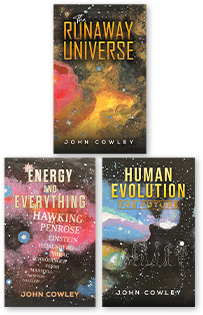
fade away in a process often referred to as Heat Death. In my books, Energy and
Everything and The Runaway Universe, I suggested an alternative in which the
Universe rather than having a single beginning - the Big Bang, and a single
ending - Heat Death, had multiple beginnings and multiple endings in a
never-ending cycle of nature that itself had no beginning and no end – the
Cyclic Universe. The mechanism by which this recycling takes place involves two
opposing forces gravity and time. Time, in the beginning, creates space for the
material universe, SpaceTime, and the formation of galaxies, stars and planets.
Black holes reverse the process creating a singularity, a potential new
beginning waiting on time and a new cycle of creation, galaxies, stars, and
planets. This continuing cycle requires energy, that ubiquitous essence that
enables being and doing, everything is energy and energy is everything. Without
energy nothing would exist and nothing would happen. It is a fundamental
principle of science, of nature, of life, that energy can neither be created
nor can it be destroyed only changed from one form to another. The universe is
now; it was in the past and it will always be in the future, changing phase
from expansion to contraction either as a whole or in part - phases
synchronised like a cosmic ballet. Time calls the tune until gravity brings
down the curtain. The stage empties, the dancers rest, the clock resets. What
are the implications for the future of our planet and all the different forms
of life that inhabit its various ecological niches. At some time in the future
our planet will be engulfed by our own sun as it expands into a much larger
star. Having used up all its hydrogen fuel in nuclear fusion over many
millions of earth years it starts to change into a swollen giant in its death
throes consuming all the inner planets, Mercury, Venus, Earth, and Mars.
However, long before this happens planet Earth will have become inhospitable to
all life as we know it and we will have either moved on to a new world or we
will have perished. Assuming of course that humans have not already destroyed
themselves and most other life forms through endless conflicts over land,
culture, and differences in religion. Who said humans were intelligent. Because
the evolution of our sun is a slow process many scientists and philosophers
will tend to put off any serious considerations claiming that humanity has
greater and more immediate concerns. This may be correct, but time has a way of
slipping away from us and events tend to overcome us before we are prepared,
like climate change for example. It may be a worthy idea to fast forward our
cosmic clock to a time much closer to the catastrophic events occurring in the
last moments of planet earth. Commencing today what would be the most important
decisions essential to prepare for the mass migration of life on earth? Many
would agree that priority one is for humankind to unite as one and pool their
resources for the mammoth task ahead. The immensity of the undertaking means
that attempts by individual nations or individual ethnic or religious
backgrounds would have extraordinarily little chance of success. In fact, there
can be no prior assurance that any combined effort would succeed but it would
provide the best chance of survival. One of the next priorities is obvious, and
space exploration is already underway to find planets with the potential to
support life as we know it. The moons of the outer planets in our solar system
may well provide a temporary home before they also are consumed by our dying
sun. At least we should be testing the type of habitats which are likely to
provide the necessities for survival on an alien world but a world we can reach
given our current technology. The idea of leap frogging our way through the
solar system may well provide the extra time we need to develop the capacity
for large scale migration to other worlds around distant stars. Building the
type of spaceships capable of carrying large numbers of humans to the stars is
in its infancy. The distances between stars are so great the population of
humans making the trip will have to be self sustaining over several
generations. The idea of a Noah’s Ark with representatives of all species of
plants and animals would be unrealistic and even the number of humans would be
exceedingly small in comparison to the earth's current population. The solution
would require successive waves of human migrations carrying with them seeds and
cryogenic ‘embryos’ compatible with the later development of a biologically
diverse self-sustaining ecosystem. This should increase the urgency associated
with preserving the diversity of life on earth and increasing protection for
those at risk of extinction. Humans may not always act in an intelligent way,
but evolution shows they are clever at adapting to changing circumstances, to
surviving. Given the task of building a starship there is little doubt that we
will succeed. it is really a matter of priority and harnessing the common will.
Of the utmost urgency is the will to end all wars and build a more loving and
caring world that includes all peoples whatever their origin, their colour, or
their religion. There is no greater truth to be gained than realising that the
peoples of the earth are all one family and their futures are inextricably
bound together. We could begin by accepting each other as we are with all our
human frailties, the good, the bad and the ugly and encourage one another to do
better. Finger pointing only helps to conceal our own lack of virtue, self deception
and perpetuates our current dilemma, a family at war with itself without hope
of reconciliation. We can do better; we must do better.
Post Views : 9